

The leg prosthesis becomes part of the body, therefore, when designing, attention is paid not only to its functional characteristics, but also to aesthetic ones . How are prototypes created, adapted to the physical characteristics of a person ? How does a prosthetic leg turn into a stylish accessory ? This article is about how 3D printing and vacuum forming help combine useful function and beauty in prosthetic legs.
In the industrial design studio KLONA create working models that will help a person stay active , engaged and stylish . Order the best prosthetic leg from us, which will imitate the functions of the missing limb, and at the same time will not scare anyone.
Content
Manufacture of Prosthetic Legs: 12 Steps
1. We examine the positions .
We find out what the motivation is, for example, aesthetics , the ability to travel or play sports , and whether there are diseases that will not allow wearing the prosthesis for a long time.

2. We select components .
We choose the design of the future prosthesis of the leg, the method of attachment and materials . The decision is influenced by the state of the stump and muscle tone , as well as the presence of allergies . If a silicone case is used, then we select its model and thickness , and then we discuss whether there will be a textile coating and what is the method of fixation .
3. We select the type of knee module if the amputation is above the knee.


4. Remove the plaster cast from the stump.
5. We make a trial sleeve.
6. We do a preliminary assembly.
7. Trying on .
We check the assembly accuracy in statics and dynamics. We adjust the height.
8. We train .
A person learns to put on a prosthesis and move confidently on it.
9. Testing.
We check the work of the prosthesis in everyday conditions.
10. We analyze flights.
We discuss the comments identified in the test mode, correct some settings, and then finalize the prosthesis.
11. Create a permanent sleeve.
We can draw a picture on request.


12. We develop the coating of the prosthesis.

Let’s talk about how cosmetic shells are made, which hide the metal parts of the prosthesis , and at the same time completely duplicate the shape of a healthy leg. And also about creating a sleeve that will be comfortable already at the first fitting.
How to Print a Naturally Shaped Prosthetic Leg: 3 Steps
The 3D printed prosthesis is a realistic coating that surrounds a metal bar and mimics the shape of a lost leg.
In order to create a coating that perfectly fits the limb, measurements are first taken, and then a prototype is made and post-processed .
3D scanning
Measurements are taken with a scanner. A scan is a point cloud that serves as a blank for modeling a rigid body. If possible, both legs are scanned – healthy and damaged .
The EinScan Pro line of 3D scanners scans the human foot in seconds.

The latest technologies allow you to take measurements from the prosthesis remotely . They are used to develop overlays with an accuracy of 99% .
After scanning, the data is processed and set up for 3D printing .
3D modeling
A 3D prototype of the prosthesis is created according to the size and shape of a healthy leg. This stage is labor intensive. The task is to create a 3D model from two point clouds obtained after scanning a healthy and injured leg, taking into account all the wishes of the client. If there is only one leg, then after scanning they create a design file, making a mirror image of a healthy leg.

Solution:
- 3D solid modeling of both legs in the SolidWorks product development CAD software package;
- the model of a healthy limb is mirrored , corrections are made for height;
- from the mirrored leg, the volume model of the damaged leg is subtracted , taking into account the allowances for skin breathing.
If the data was acquired from an EinScan-Pro 3D scanner, it is exported to Geomagic Essentials , a software for transferring scan measurements to a CAD platform. Processing is carried out in the Solid Edge program, which is designed for reverse engineering 3D scans.
A 3D model of the future prosthesis is sent to the customer along with a library of templates . The selected template will become the basis for the covering , flowing around the prosthesis.

You can design and create a 3D model of prosthetic fixtures in SolidWorks and then integrate it into the main 3D model .
3D printing
After the designer and the customer agree on the design , the final digital file is sent to print .
This is the final stage. The white plastic PA 2200, also known as polyamide , is ideal for a prosthesis that will be used frequently as it is lightweight and durable .

In the production of polyamide prostheses, selective laser sintering technology is used, in which the laser builds up a three-dimensional model in the right places.
After fitting the prosthesis, the following are analyzed:
- how fasteners work;
- whether the body sat on the leg;
- whether a layer is needed between the stump and the prosthesis, since the limb sweats;
- roughness of the texture of the material.
The first prototype is fully 3D printed and then post-processed to make the prosthesis look complete.

Development of the design concept of prosthesis shells, 3D printing
contour covers
Made according to taken measurements, weight ≈ 400 g .
When developing it is important:
- study the design of the prosthesis;
- consider how to fix the contour cover so that it does not cling to anything and does not prevent the artificial limb from bending;
- make sure that the part imitating the calf muscle is not low , as this looks unnatural.

Concept: Wear prosthetics like fashion, change like watches and cell phones.

Such a cover visually makes the leg prosthesis a stylish accessory , similar to a modern gadget .

In models where graphics are applied, special foil is used. The surface is often meshed for ventilation .

Thanks to the aesthetic coating , which is put on the prosthesis and shapes the shape of the leg, it is possible to wear a dress and tight jeans . Four designs of the core were made: ribbed, solid, with diamond-shaped and cylindrical holes.
Chip : instead of liquid resin, plastic powder fused with a laser is used. This makes the material durable .
Prosthetic leg Art4Leg
The Art4Leg concept is beautiful and customized skins.

Feature : the cover is attached to the prosthetic leg with strong magnets , so it can be fixed or removed in a few seconds. Magnets hold the front and back panels tightly .

Prosthetic leg Alleles Design Studio

Canadian studio Alleles Design Studio has developed a collection of prosthetic legs that restore the human silhouette . These covers have a natural shape. Patterns and colors are selected to match with clothing .
Unusual leg prostheses, 3D printing
Onlays turn a prosthesis into something amazing, not only through patterns, graphics and tattoos, but also through materials such as leather , ballistic nylon fabric and chrome plating .

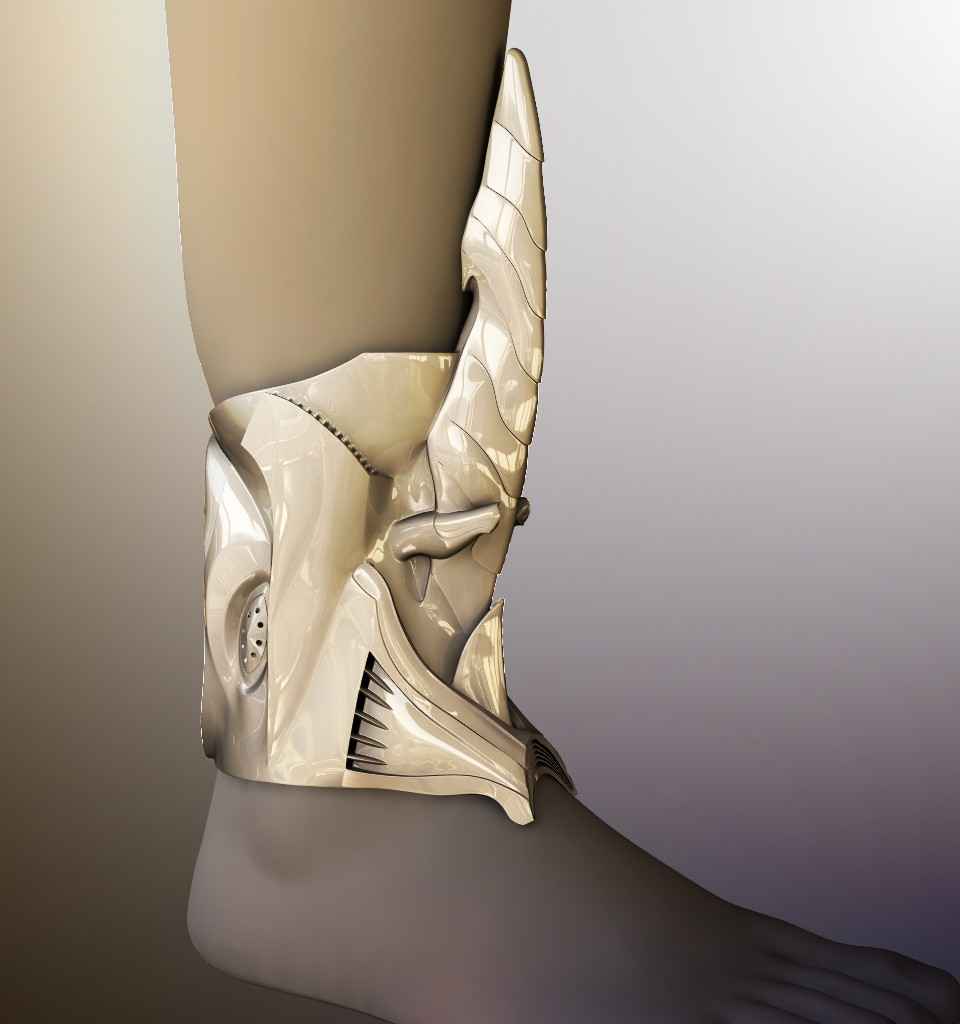
The goal of the designer is to make the prosthesis unique . Styles range from medieval to high tech.

The body is made of nylon and resin . To create a frame that is easy to put on, designers work with 3D scans.


See also: Why bionic leg prostheses are more interesting than mechanical ones: industrial design
Creating prosthetic legs: examples
Leg prosthesis by Bespoke Innovations, 3D printing
The design goal is to combine robust construction and custom design .

Industrial designer Scott Summit 3D prints beautiful prostheses.
An accurate graphic model of the prosthesis is created using 2D and 3D drawing software. These are GeoMagic , a program for transitioning from a 3D scan to a CAD model , and Pro/Engineer Creo , a full-featured CAD program for developing virtual models.
The prosthesis is made using 3D Systems Selective Laser Sintering, a printing technology in which layers of material are fused into a part with a laser .
The leg was printed based on a scan of a healthy leg on the opposite side of the body, as well as additional biometric data. This artificial limb has one joint for the knee , which makes the assembly of parts more reliable.
Feature : 36 ceramic bearings surround the knee shaft , so the entire leg is waterproof .
The knee is blocked by a built-in belt brake . Prosthesis material – Duraform EX Black, polyamide .
Upya prosthetic foot, 3D printing


3D printed parts can be assembled in less than five minutes and can also be customized to fit the patient. Materials : reinforced polyamide , fiberglass, aluminum and polyurethane foam.
The design of the prosthetic foot is based on biomimicry . Its purpose is to provide a comfortable walking experience. The blade set, spring and cushioning system mimic tendons and muscles to replicate the energy and dynamics of the human stride.
Ankle, heel and toes are shown in the form, which can then be encased .
Leg exoprosthesis, 3D printing

Such a leg is an alternative to the traditional robotic prosthesis due to 3D scanning , modeling and printing technologies. The created titanium exoskeleton accurately reproduces the shape of an amputated limb .
Using FitSocket technology, leg tissues are analyzed . Measurements are taken to the nearest millimeter .
The 3D mesh model of the prosthesis is combined with the standard mechanisms inside the exoprosthesis.

To personalize the prostheses, patterns are made from a lightweight but durable titanium mesh, the color of which the person chooses. To reduce weight, the frame is hollow and can be coated with silicone .
Printed as a single 3D exoskeleton, the prosthesis is immediately ready for assembly . Using 3D printed connectors , standard prosthesis components are inserted into the leg and secured securely.
Stylish prosthetic leg from Bespoke Innovations, 3D printed

The style of this cover is a black lace pattern on the front and a shiny chrome back. The leg has returned to its natural shape , and the girl can wear skirts and dresses again, as well as change different fairings depending on her mood, activity or clothes.

A 3D printer can print three-dimensional models in plastic , plaster, or metal . The resulting prosthesis will fit a person in size , while it will be comfortable and beautiful.
See also: Bionic prosthetic hand: industrial design for a fulfilling life
Vacuum forming prosthetic legs
When molded, the overlay is lighter , stronger , and requires less processing than 3D printing.
Technology: sheet plastic is heated, then stretched around the matrix under the influence of suction, and as a result takes on a given shape.

With this technology, the overlays are made of sheet plastic , and additional parts and fasteners are printed out. The fairing is then painted and textured . The design is taken from the catalog or developed to order, for example, you can make a backlight .

The main step in the production of leg prostheses in vacuum forming is to create a matrix . To do this, workpieces are milled from aluminum or from MDF sheets (Medium Density Fiberboard). To reduce costs, matrices are printed on a 3D printer, and a size ruler is also created.

Production stages:
- creation of a computer model of the prosthesis;
- design overlay on a 3D model;
- fabrication of the overlay matrix ;
- molding and cutting parts from sheet plastic;
- printing some details on a 3D printer ;
- assembly of the finished lining.

Creation of a sleeve for a prosthetic leg, 3D printing

A laser scanner and computed tomography are used to capture the patient’s stump. The DICOM data from the CT is converted into a 3D structure in the InVesalius software and then compared with the data from the laser scanner. *.stl files are imported into the CAD program. Now you can start designing based on the anatomical data of the patient.
The bell design is tested using FEM analysis . This way you can be sure of the mechanical strength of the sleeve printed on a 3D printer before it is received by the patient.
After the tests are completed, the sleeve is printed on a 3D printer, such as SLS HiQ. Then the sleeve is combined with a complete prosthesis.
Such a sleeve is convenient from the first fitting – you need to adjust a single screw .
A Squirt Shape 3D printer is also suitable for printing sleeves.
Outcomes
3D printing makes prosthetics cheaper and makes custom post-processing and customization easier and more affordable . In simple cases, a person can print an artificial limb himself. The desired model is loaded from the Internet, and then adjusted to fit its parameters.
3D technologies make it possible to create light , strong and comfortable shells , as well as sleeves for prosthetic legs that exactly fit the measurements . In addition to onlays and sleeves, additional parts of the prosthesis are printed on a 3D printer: a sleeve , a support, a suction socket , as well as well-fitted liners . The design of the inserts is interesting: two forms slide, and the silicone material fills the voids between them. This is for those who have an atypical stump shape or sensitive skin.
Order a prosthesis in the industrial design studio CLONE . We will design and build a comfortable , durable and good-looking artificial limb that will last a lifetime.


